“Reality, Robots, and Religion” or… “Of Christians and Computer Scientists”

The past weekend saw the Faraday Short course take place in conjunction with our subproject on the implications of developments in AI and Robotics. From Friday to Sunday members of the public could listen to invited speakers, engage in break out discussion groups, and even grill the speakers mercilessly during an evening panel!

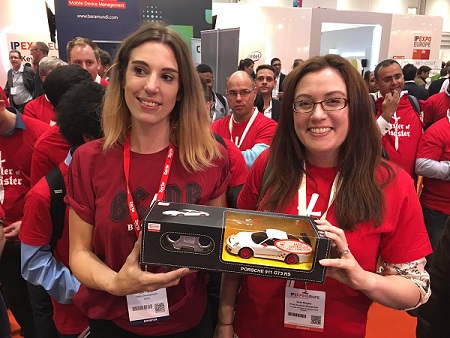
faraday-short-course-pic

Photo by Gavin M.

The short course went extremely well in terms of organisation and in the generation of conversations. Anyone seeking definitive answers might have been disappointed, but in part the course was addressing what a religious response to the questions raised about AI and robotics might look like – with, at this point, that response limited to Christian interpretations.

The Faraday Institute is very successful in bringing together those voices that we might initially think to be in opposition. Thus it was fruitful to note where those who were overtly secular in fact agreed with those who were religious. That was one of the main arguments of my own talk for the course: that future tech focussed groups in fact draw on their home-context of religious eschatology in the formation of their science ‘fact’ speculations about the future of AI and robotics. My two particular examples, drawn from conference papers I have given previously this Summer, were the pragmatic attempts at the development of a “Theism from Deism” and a Transhumanist Church, and the potentially ‘tremendum et fascinans’ implications of certain Singularity thought experiments such as Roko’s Basilisk.

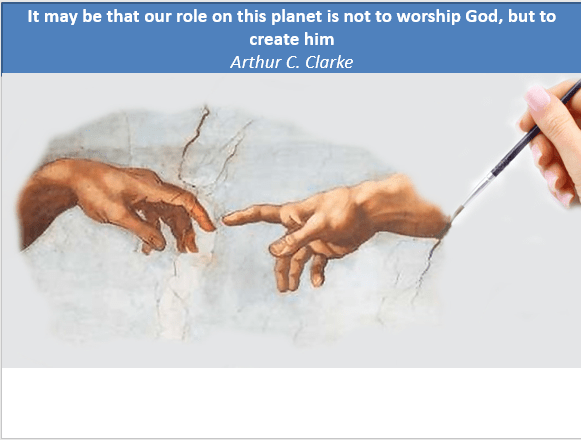
prisco-arthur-c-clarke

A slide from a presentation by the Transhumanist, Giulio Prisco, from the 2014 Mormon Transhumanist Conference – presented during my paper at BASR 2016 earlier this month.

However, during the course it was interesting to see both Computer Scientists and Christian Theologians refer to belief in the personhood and/or intelligence of potential AIs as a “category mistake”, drawing in part from Ryle (1949), Searle (1980) and Kelly (1994). This dismissal came at the concept from two apparently distinct directions of the ‘secular’ and the ‘religious’, but they found agreement in their views during the course – or at least those that discussed this issue with me did.

However, I am convinced that there are another two issues that complicate this apparent certainty and agreement. First, and perhaps quite obviously, anthropormorphism makes this “category mistake” somewhat irrelevant. As another speaker noted, all we ever have from other humans is appearance of genuine intelligence – even emotions – to the extent that the speaker raised the possibility that their long time friends might in fact have been “acting out” the friendship. But should the speaker die without knowing this, then there would be no difference in effect than if they had been ‘genuine’ friends.

In some ways, as the lone social anthropologist – as far as I am aware – I felt like this was a conversation catching up with something participant observers have known for a while. I have perhaps been more aware of this issue, being a researcher in digital communities, and being regularly asked if I can believe anything that I am told by someone online – in particular about their religious belief.
internet_dog

computer-online

My answer, and my answer if I was asked about the ‘genuiness’ of a robot’s response, has been to point out that we take things for granted in face to face conversations with humans as well. You tell me your name, how you are feeling… even what you believe. How do I know that you are telling the truth, or even further, that there is an intelligence seperate to me actually having these genuine experiences? We give benefit of the doubt with every human we ‘meet’ – even, or especially, online.

Second, as J. M. Bishop states in his 1995 review of Kelly’s 1994 book:

Kelly meticulously examines the claims, achievements and underlying philosophy of proponents of AI, highlighting the limitations of each theory, with the effect that reading the book is rather like being confronted by a slow moving traction engine. By the end only the most religious practitioners of AI will have moved to apostasy.

In this statement Bishop intends to highlight Kelly’s successful argument, but he accidentally draws attention to what I see as the second issue in relation to the ‘category mistake argument’. There is a strong element of the religious to a continuing belief in AI as potentially becoming a genuine person. That religious, and particularly eschatological, influence was what I wanted to bring attention to in my paper. And Bishop himself is obviously not immune to that influence: he refers to the “most religious” and those who have (rightly in his mind) moved to “apostasy”.

Even overly secular responses to AI and robots draw on the religious context – primarily the Western Christian understanding of the shape of the future and of what a supreme intelligence or being might look like – in their discourse. Paying attention to this influence is key, as I said in my paper, because this shaping by religious eschatology can underlie claims about the future of AI, make certain individuals influential (or even charismatic), and be used to generate interest in funding applications for particular technological developments (see Geraci, 2010).  As a New Religious Movements scholar this aspect of developments in AI and robotics particularly interests me, and will form the basis of my continuing research in this area.

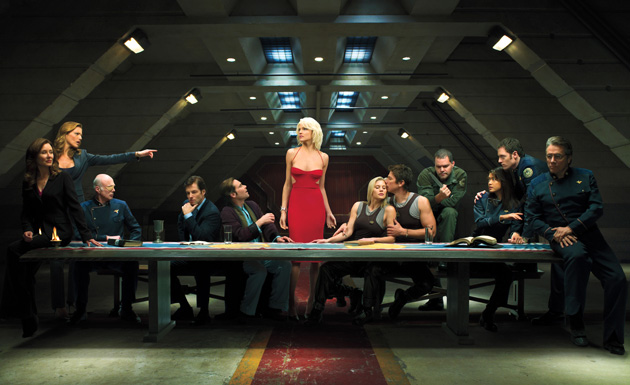
bsg

TL;DW

I’ve been rather busy lately writing conference papers (details below) and I havent unfortunatly had the time to write the rants blog posts that came to mind off the back two AI and robotics stories this month. Even the versions I came up with in my head became TL;DW (too long; didn’t write), and would no doubt also have been TL;DR (too long, didn’t read) by anyone coming upon them on this blog. Instead, here are the stories – with some thoughts added – in as brief a form as I can manage!

First, reports that the Turing Test is intrinsically flawed because an AI could basically plead the fifth and remain silent, making the test null and void, “allowing it pass as a sentient being”, and that objects like rocks could also pass!

speak no evil

1. Why is a study by two academics at a UK university assuming the AI will come under the governance of US laws? Okay, perhaps we could take “pleading the fifth” more as an expression than a legal recourse. But even so, what are the assumption about nationality at play in the AI community? Does nationality even have a part to play when the key organisations and corporations considering and working on AI  are so international?

2. Isn’t pointing out problems with the Turing Test a little redundant? I’ve heard it said, and I tend to repeat it, that any AI smart enough to pass the Turing Test would also be smart enough to fail it on purpose! And let’s consider the origins of the Test. At first it was about seeing how well a computer could pass for a woman. While of course women are examples of sentient and intelligent life (!!!), there may also have been the aim of seeing if it was possible to replace the administrators and coders, women primarily at this time, with computers in an efficiency drive. The test was also less about proving a human intelligence and more about ‘passing’ for human – in an era of Cold War subterfuge and the passing of spies for colleagues. Any attempt to ‘pass’ the Turing Test off as a precise scientific proof for intelligence is intrinsically flawed. Likewise, any new critique of it needs to pay attention to prior commentary on its origins and presupositions before making announcements that it doesn’t work.

Likewise, and as in the second story that caught my eye, references to Asimov’s Three Laws of Robotics in relation to real world events needs a more careful consideration of their origins, aims and flaws. That is not to say that I am dismissive of them because they originated in science fiction. In fact, I am very much against the bracketing off of popular literature because it is popular, or even ‘not grown up’. In the preface to an otherwise excellent book, “What to Think about Machines that Think”, edited by John Brockman, he states: “This year’s contributors […] are a grown up bunch and have eschewed mention of all that science fiction and all those movies…”

Pfft.

But back to the story where Asimov’s Laws were invoked. A mall based robot ran over a toddler, hurting him, which of course should not have happened, and if it had been my son you’d have been finding bits of circuit boards all across the shopping centre for weeks after. But the stories all referred to the robot as having broken Asimov’s first Law of Robotics: “A robot may not injure a human being or, through inaction, allow a human being to come to harm.”

asimov

Well…

1. Unlike the laws of a country, you cannot be held to a law of robotics that you havent been programmed with/are aware of. So, perhaps this is a tongue in cheeck comment. But it betrays a certain expectation about robots and regulation that I have seen elsewhere, a presumption that Asimov got it right and that we already have a system that could be implemented to ensure robotic behaviour. Which ignores…

2. That Asimov’s Laws don’t actually work in his stories! Because if they did, there would be no story! They are a narrative catalyst, there to spark incident and to allow Dr Susan Calvin the opportunity to show of her cold intelligence as a robopsychologist, or for Donovan and Powell to chummily muddle through to a solution.

3. The articles also generally ignored the fact that Asimov introduced a Zeroth Law (or that it evolved among the Superintelligent AI minds that govern the world in his later stories), whereby, “A robot may not harm humanity or, through inaction, allow humanity to come to harm.” This is a strict moral utilitarianism that allows the Superminds to make decisions harming a limited number of humans for the greater good, something that Dr Calvin sees the logic in. I’m not suggesting the mall robot was doing anything other than failing to recognise the boy as a smaller example of the shapes it was meant to avoid (NOT the same as being programmed with the first law), but if news articles are going to cite Asimov’s Laws of Robotics then perhaps they should be aware of where they lead to…

Perhaps this TL;DW has now become a ‘too long;ended up writing it anyway’ (TL;EUWIA isnt going to catch on though). But I’ll finish up now with the titles of the conference papers I am working on at the moment:

Ian Ramsey Centre conference on Post-Secularity, Oxford, 27th – 30th July:

“LessWrong = Less Religious?: Secularity as Moral Boundary Making in Future Technology Focussed Groups”

Affective Apocalypses and Millennial Well-Being Conference, Queens University Belfast, 18th – 19th August:

“‘It’s the End of the World as We Know It (And I Feel Fine)’: An Ethnographic Comparison of Existential Hope and Existential Distress in Transhumanist and Apocalyptic Artificial Intelligence Groups”

BASR Conference 2016, Wolverhampton, 5th – 7th September:

“The Possibility of a Religion: Artificial Intelligence, Science Fiction, and New Religious Movements”


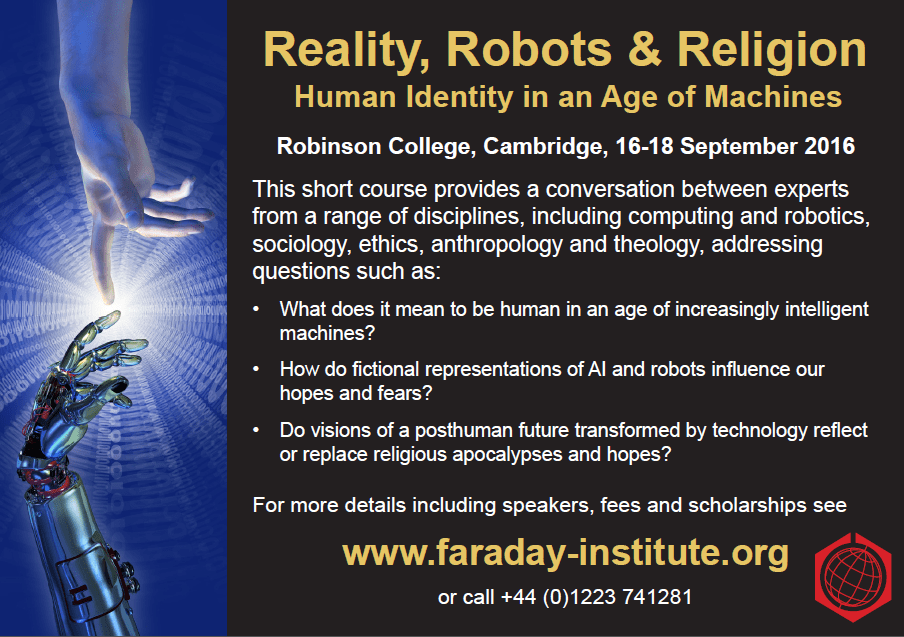
Short Course: Reality, Robots and Religion

NEWS:

Professor Richard Harper has recently joined the expert speakers for our Faraday short course in September. He will be speaking on “Communication, God, and Machines”:

Short Course Advert Small

He joins luminaries including Lord Martin Rees, Professor Nigel Cameron and Professor Susan Eastman (full list of speakers here, with details of how to register for the weekend)

The aim of this weekend event is to address the personal, societal and theological implications of advances in Artificial Intelligence (AI) and Robotics. These issues are complex, multifaceted and highly contested. Our aim is to host a conversation between participants from a range of disciplines, including computing and robotics, sociology, anthropology, ethics and theology.

I hope you can join us!


Beth


Writing the Script for AI

Yesterday afternoon was spent writing a film.

script

You might start to imagine screenwriters in bottle top glasses hunched over typewriters, with fat producers stalking behind them waggling thick cigars in smoke-filled writers’ rooms decorated with slatted blinds and green glass lamps.  However, we were in a teaching room in St Edmund’s college working on our short film as a part of the Cambridge University/Wellcome Trust Short film scheme. Although the final title is still under discussion, the general theme will be “Could, and Should, Robots Feel Pain?”

Partly this topic has come about because the scheme requires that the two academics generating the idea for the film should be an interdisciplinary team of Arts, Humanities and Social Sciences, and Biomedical Science. This meant that a few months ago I took part in a networking event where blue spots (Arts, Humanities and Social Sciences), sat at tables and introduced themselves and their research to revolving sets of red spots (Biomedical Sciences). Apart from feeling awkwardly a bit like speed dating, this event demonstrated the diversity of the research going on at the university, as well as the difficulty of finding common themes and aims between them. In fact, in a few cases, I met Red Spots who just wanted to use the Blue Spots to do all the writing for the film without much input into the idea behind it!

Luckily, I met Dr Ewan Smith on one of the rotations of the tables, and he was not only interested in a proper collaboration between our projects, but his research on pain (in naked mole rats!) suggested an interesting overlap in interests with a bit of speculation and theorising thrown in.

A month or so later and our proposal was accepted for the scheme (along with proposals by four other teams of researchers), and Ewan and I were back in rotation, this time at a networking event with filmmakers who had expressed interest in producing the actual short films for the scheme. We met many interesting, and very creative, people, but two seconds into the room I had bumped into one filmmaker who mentioned that he was already making a feature-length documentary on Artificial Intelligence. “Oh, well you won’t want to be involved in our project as its too similar,” I said, shrugging. But Colin Ramsey of Little Dragon Films was not put off.

Then we get to yesterday: myself, Ewan, Colin, and James Uren, Colin’s co-producer, in a college teaching room on a humid day in June discussing the beats of a ten-minute film on the technological details and the theoretical implications of pain being a part of the design of non-human others. We discussed the science and who we wanted to interview, the possible reasons why humans might create robots (or embodied AI) that could feel pain, whether they could experience the emotional aspects of pain, and, getting into the meta-level of the questions, what might be the reasons for our reasons for attempting this?

In some ways, this kind of script development meeting is not that unfamiliar. In a previous life, I worked in the film industry on fiction scripts. I even got a degree from the National Film and Television School in Script Development before I decided to return to academia:

NFTS
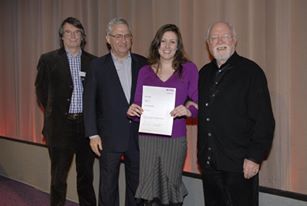
Receiving my NFTS degree certificate from Sir Richard Attenborough

A key similarity struck me when we were going through the structure of the short and asking ourselves again and again, “What do we want the audience to be thinking/feeling here?” Attention to the audience in the fiction-based film industry has led to some accusations of scripts being written by the numbers, or accusations of pandering to the whims of market research (*cough* test screenings *cough*). Certainly, back in the stone age when I wrote reports for film companies on their incoming scripts (mostly headed for the slush pile), a major section was always on the expected audience and whether the script was successful in engaging with them – often with a quantitative assessment; giving the script a final mark. Further development of the script often involved thinking about narrative conventions and the audience’s expectations for things like romantic journeys, a moment of self-sacrifice, or the obvious one, the ‘Happy Ever After’. Some even with a specific timestamp of when they should appear in a film.

In the case of our short film we have an idea of the levels of engagement we hope for from the audience, but no such near algorithmic attention to popular forms and tropes and how they ‘should’ fit together.

Which brings me to another short film I’ve been thinking about lately: Sunspring. This science fiction short film was written by artificial intelligence, as the blurb explains:

In the wake of Google’s AI Go victory, filmmaker Oscar Sharp turned to his technologist collaborator Ross Goodwin to build a machine that could write screenplays. They created “Jetson” and fueled him with hundreds of sci-fi TV and movie scripts. Shortly thereafter, Jetson announced it wished to be addressed as Benjamin. Building a team including Thomas Middleditch, star of HBO’s Silicon Valley, they gave themselves 48 hours to shoot and edit whatever Benjamin (Jetson) decided to write.

Watching Sunspring you would never be tricked (a la Turing) into thinking this was the product of a human – the disjointedness of the dialogue, the obscure plot (if any) and the repetition of lines asking what is going on, or questioning what the other character just said, make it clear that this is something artificial. The performances bring life to these stilted lines, but Hollywood has little to fear from this automation of creativity. Although, the same technique, refined, could be seen as a logical next step on from the near robotic plotting of some contemporary blockbusters. Script development, as I’ve said, works on similar principles or rules of story. That Benjamin is still learning these perhaps makes him a neophyte screenwriter (perhaps he still hangs out in Starbucks rather than BAFTA) rather than a failure. Returning to filmmaking with our own short film for the Faraday’s AI and robotics project has reminded me of some of my own neophyte-ness as a screenwriter. Perhaps the difference is the attention we want to give to the audience’s engagement and education through the film, whereas Benjamin was simply asked for a script so he made a script. A balance between the two extremes of ignorance of the audience and pandering to it after research would make Benjamin a more convincing screenwriter. Although, what would our reasons be for creating a good AI screenwriter?

robot writer

Perhaps, at least initially, it’s because it makes a good story. But what do these storytellers want us to feel/think in reaction? Reactions online have varied between parody, pointing out similarities with other feature films with equally incomprehensible plots and dialogue, anger that they wasted the 9 mins and 3 seconds watching it, to quotations of the lines that affected them emotionally (comments on Youtube: ‘”I was much better than he did” How come i cant get this line out of my head?’, ‘”He looks at me… and he throws me out of his eyes.” I have no idea why, but that line is incredible!’, ‘This is exactly like a dream. Absurd and yet, deeply emotional.’).

Whatever the reason, I suspect the meta-reason is something like an innate need to frame and then code/write the non-human in human terms: an AI should do the things that we can do, including writing film scripts, because human activities like that make sense to us (even if their products don’t, as yet!). What a true AI would choose to do might still be beyond our conception. Just as they could not have known that Jetson would become Benjamin. That was not in the script for the AI.

Ex Homine – On Artificial Intelligence and Humanlikeness

Trust the anthropologist to talk about humans at a conference on Artificial Intelligence…

Yesterday I spent an extremely stimulating day at the Rustat Conference, held at Jesus College, where the topic was “Artificial Intelligence – the Future Impact of Machine Intelligence”. Chatham House Rules prevent me from describing who said what exactly, but there were panels and talks on “Ethics,  Regulation  Responsibility”, “From Artificial Intelligence to Super-Intelligence”, and “AGI and Existential Risk”, and attendees included leading figures in the AI tech research world, as well as academics, financiers, and entrepreneurs. If you are interested in the field of AI you’d have known many of the people attending. Being invited to attend, and to come along to the pre-conference dinner the night before, was an honour for this new minted post-doc!

But perhaps I should reframe my first sentence. ‘Humans’ were in fact in evidence in many of the conversations, with discussions of the possibilities of a universal Basic Income for a humanity that will possibly be displaced by automation, in discussions of state and individual human ideologies that might come into conflict with AI futures, and in considerations of the ‘humanlikeness’ of AI.

The latter stirred me to make a point, drawing, as the anthropologist in the room (although not the only one, as my PhD supervisor was a speaker) on some ethnographic examples. I am not entirely convinced I was clear in my point so I want to expand on it here.

One of the discussions involved mapping scales of consciousness and ‘humanlikeness’ for both current and theoretical future AI, with the proviso that both concepts are quantitatively, and semantically, difficult. But as an example, a brick would score at a low point for both, while Ava, the embodied AI from the film Ex Machina would hypothetically be placed further up and to the right on these x and y axis. Recognising this proviso, my issue was with the idea that ‘humanlikeness’ is an objective quality. After this point about scales there was a discussion in which the point was made that technology simply  cannot have an essence that would make harming it a problem: we are not concerned by the thought of people torturing iPhones, which raised a laugh from most of the attendees.

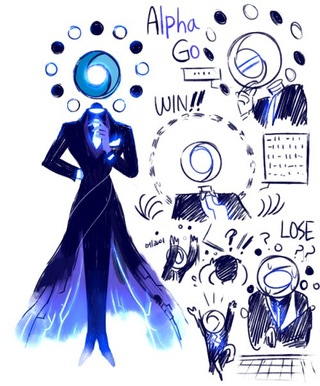
To me this is to misunderstand ‘humanlikeness’ and to ignore an incipient and prevalent anthropomorphism in response to AI. For example, AlphaGo the program developed by Google DeepMind would score only slightly higher than a brick on these ‘objective’ scales of humanlikeness and consciousness. Its only human quality is that it plays a game, and there is no claim for its consciousness. And yet… fan art in response to the program’s success has AlphaGo as a young anime style boy or girl (the latter is also interesting because of the gender issues around professional Go, although drawing females may simply be more aesthetically pleasing for these artists).

So here we have:

alphago-3

(nb the second AlphaGo, by Anon or the same artists, has mechanical hands, and is therefore less ‘humanlike’ than the one on the left by @rakita_JH)

alphago1

Young male AlphaGo by Otokira-is-Good

alphago_by_nunsaram-d9v6g5w.png

AlphaGo by Nunsaram (again this AlphaGo has mechanical hands choosing vertices on a holographic seeming Go board, mechanical rabbit-esque ears, and is connected by wires to… something…)

alphago6

AlphaGo by Knocker12. in this case a more abstract humanoid, with a touch of the Tuxedo Mask about ‘him’.

That these anthropomorphisms are variable in their humanlikeness (the mechanical hands, abstract head, wires, animal ears) shows again that the axis of ‘humanlikeness’ is interpretive. Likewise, we might presume differing levels of presumed consciousness by these artists. So, we might note that the last AlphaGo is presented by Knocker12 as a little linguistically simplistic in its bouts with Lee Sedol:

alphago full.png

Whereas, some versions are more verbal, if still using ‘computer speak’

Alphago resign.png

Of course, there is a case to be made for a general anthropomorphism among humans, the same kind that led to interpretations of more natural phenomena and animals in terms of human like intentions, and perhaps led to instances of the deification of phenomena and the non-human.(1)

However, in the context of discussions about AI, a potential new non-human intelligence, perhaps we need more reflexivity about how we mark the distinction between the human and the non. Paying particular attention to the entanglements of anthropomorphism and personification will impact how we understand our positioning of these technologies on any imagined scale of humanlikeness, and therefore how we interact with them (especially when a diminished attribution of humanlikeness might be behind justifications for abuse).

Therefore, laughter at the thought of being concerned at the torture of iPhones ignores this mass anthropomorphism. In discussion I also drew attention to the public reaction on social media to the Boston Dynamics videos of their prototype robots being knocked down or tripped up. While they were not ‘hurt’ in a way that might be objectively measured, human reactions again anthropomorphised these events, and cries of “Bully!” could be heard online.

Some responses online were obviously more tongue in cheek, as in this spoof charity video, but others were more concerned for the ‘poor’ robots (or even, concerned about humanity’s future after a hypothetical ‘Robot Uprising’, when our new overlords might look back at our actions with regards their ancestors!)

Although, and I admitted this at the time, the conference was not really about robots of this kind and therefore this example was perhaps a side point (although, embodied AI, and the importance of embodiment for real consciousness, was also discussed during the panels). But any discussion of humanlikeness has to take into account how humans subjectively apply the quality to the non-human, especially when this is in surprising ways in a general human populace that is much wider than those dedicating themselves to AI research. Considerations of the future of AI will certainly need an awareness of perception, inference, and anthropomorphism, and this is an aspect that the anthropologist can contribute to by paying attention to responses outside of the conference and the research lab.


(1) This ‘next’ step is of interest to me, and it is interesting to note that Knocker12 also represents AlphaGo as a many armed god, although this is outside of the immediate point of this post:

Alpha Hindu.png


A Postsecular Age? New Narratives of Religion, Science, and Society, 2016 IRC Conference, Oxford, 27-30 July

I heard this week (just before my viva, so it slipped my mind a little!) that my paper for the Post-Secularity conference at the Ian Ramsey Centre was accepted! I’m pleased to be presenting on:

LessWrong = Less Religious? Secularity as Moral Boundary Making in Future Technology Focussed Groups

I am also very happy to hear that some really great academics will also be involved, such as S Francesca Po and Rebecca Catto  both of whom I have crossed paths with before 🙂

In my experience, conferences are one of the delights of being an academic and I am very much looking forward to attending!

The Spinning Wheel of Death – Doomsayers and AI

I hope that you’ve never experienced the Spinning Wheel of Death. But if you are a Mac user you may have had that gut wrenching moment of despair when everything freezes, the app you are using judders to a halt, and all you can do it watch, hypnotised by the rainbow wheel that spins, and spins and spins…

spinning wheel of death


What’s making me think about this little beach ball of evil this sunny morning? I saw on my Twitter feed that in March TechEmergence published the results of interviews with 40 AI experts on what they think is the most likely AI risk in the next 20 years.

TechEmergence have displayed this data in a rather neat spinning wheel inforgraphic made up of 33 of the researchers and their bio pics, grouping them and some of their one-liners into seven categories of risk (you can subscribe to be sent the complete data set as a spreadsheet, which also includes longer term predictions). These categories are:

  1. None Given (6 researchers)
  2. Malicious Intent of AI (1)
  3. General Mismanagement of AI Technology (5)
  4. Superintelligence (2)
  5. Surveillance/Security (3)
  6. Automation/Economy (12)
  7. Killer Robots (4)

The respondants are a mix of technological experts and more philosophically inclined researchers like Dr Peter Boltuc.

Ignoring the fact that this wheel of predictions could easily be submitted to the Congrats, You Have an All Male Panel! Tumblr (I found Joanne Pransky hidden away in the data set but not on the infographic), I have a few issues with this research and its presentation.

First, the coding. In particular the category of ‘None given’ for answers on risk like:

“The revelation that human minds may not be as wonderful as we all thought, leading to the inevitable humiliation and denial that accompanies significant technological breakthroughs.” (Dr. Stephen Thaler)

This kind of existential risk might be more worrisome than just assuming Humanity will go through some sort of ’emo’ phase as its place in the ‘centre’ of the universe is displaced. Responses could be far more significant, including but not limited to: putting new technology to  use in new religious narratives as this once stable category (our singular superiority) is displaced. If you don’t think the emergence of these narratives can be significant consider the impact of long distance communications (ie the telegram and Morse Code) on the emergence of spiritualist ideas about our ability to communicate with an ‘afterlife’. This  communication might be an idea that you do not subscribe to, but it has had an impact on society, around the world, since the 1900s. Not least in the development of the New Age movement and in the emergence of specific New Religious Movements that aim to connect their believers with an afterlife.

“My company is working on new technologies to prevent those kinds of risks on that time scale.” (Dr. Steve Omohundro)

This comment hardly denies risk, it just assumes that they can be combatted by other technologies. Technologies perhaps with their own inherent risks…

MatryoshkaRobot

“The biggest risk is some sort of weaponization of advanced narrow AI or early-stage AGI. This wouldn’t have to be killer robots, it could e.g. be an artificial scientist narrowly engineered to create syntheticpathogens— or something else we’re not currently worrying about. Human narrow mindness and aggression, aided by AI tools that are more narrowly clever than generally intelligent or conscious. That’s what we should be worrying about, if anything. Fear of advanced AGI is mostly just generic “fear of the unknown”, and tends to be based on insufficiently deep thinking about the open-ended nature of intelligence.” (Dr Ben Goertzel)

Again, here’s a whole bunch of risks. The distinction between narrow AI and advanced AI is a key one to make, and not one expressed by TechEmergence in its introduction or framing of this work. Clarity on such terms matters:  words impact the conceptions people have of this risk that TechEmergence is trying to give a picture of. Likewise, coding military applications of AI as ‘Killer Robots’is leading, and also not a fair description of comments like:

“Intelligent drones bringing military competition to the next level.” (Dr. Peter Boltuc)

The ‘Killer Robots’ trope owes a fair deal to films like Terminator – images from which are regularly wheeled out in articles on Artificial Intelligence because, according to a journalist I spoke to recently about this, a “sense of narrative investment, if not baggage, is valuable, I think. Otherwise the robots can feel inert”. TechEmergence however makes claims to some neutrality: in the dataset is a page of disclaimers, including:

“It’s remarkably important for me to make it clear that I am neither a techno-pessimist or a techno-optimist. In general, we don’t pursue interviews or ask questions to garner “cool” or “futuristic” answers. Rather, our aim is to get a legitimate lay of the land from researchers and experts who know what they’re talking about. TechEmergence exists to proliferate the grander conversation rather than to push a particular set of beliefs or predictions.”

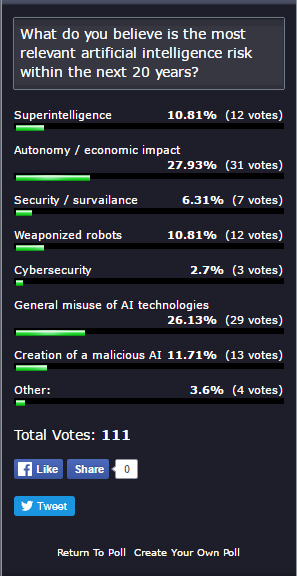
But words have impact. The Spinning Wheel of Death (see, this post has biased you to thinking these researchers are all doom-sayers…) rests above a survey for readers, dividing risk again into categories, with ‘None given’ replaced by ‘Other’ with a write in box for responses. So far there have been 111 responses:

Artificial Intelligence Risk – What Researchers Think is Worth Worrying About   TechEmergence.com

This survey does not directly match the categories applied to the AI researchers’ answers. We can note that ‘Killer Robots’ has been replaced with ‘weaponized robots’, and ‘Cybersecurity’ seems to be in the place of ‘Malicious Intent of AI’, although these are hardly equivalent. It would also be interesting to see what was written in for those ‘Other’ answers.

I think what most drew me to the Spinning Wheel of Death is that – in words that its creator uses when discussing the neutrality of TechEmergence on the subject – is that its about beliefs and predictions. The voices involved are key figures in the consideration and development of AI, so they speak from experience. But we don’t really know what risks lie ahead, this is crystal ball gazing.*

And I find that extremely fascinating. Not quite Spinning Wheel of Death hypnotising perhaps. But remember, that ball only appears when someting has gone wrong with our advanced tech, something perhaps unpredictable. Just like AI.


*Another spiritual ‘technology’ influenced by real world developments in communications tech at the time


Don’t Read This Post

I’ve recently had a paper accepted for the 2016 ‘Denton’ Conference on Implicit Religion. This is the first piece of research coming out of the Faraday AI and Robotics project, so its very exciting to have been accepted!

Here’s the abstract, and once you read it and learn about Roko’s Basilisk you’ll know why I titled this post as I have!

Roko’s Basilisk, or Pascal’s? Thinking of Singularity Thought Experiments as Implicit Religion

 “The original version of [Roko’s] post caused actual psychological damage to at least some readers. This would be sufficient in itself for shutdown even if all issues discussed failed to be true, which is hopefully the case.

Please discontinue all further discussion of the banned topic.

All comments on the banned topic will be banned.

Exercise some elementary common sense in future discussions. With sufficient time, effort, knowledge, and stupidity it is possible to hurt people. Don’t.

As we used to say on SL4: KILLTHREAD.” – Eliezer Yudkowsky, July 2010

This KILLTHREAD command came in response to a post written only four hours earlier on the ‘LessWrong’ community blog by ‘Roko’. A post which had introduced a rather disturbing idea to the other members, who are dedicated to “refining the art of human rationality”, according to LessWrong literature.

Roko had proposed that the hypothetical, but inevitable, super-artificial intelligence often known as the ‘Singularity’ would, according to its intrinsic utilitarian principles, punish those who failed to help it, or to help to create it.  Including those from both its present and its past through the creation of perfect virtual simulations based on their data.  Therefore, merely knowing about the possibility of this superintelligence now could open you up to punishment in the future, even after your physical death.  In response to this acausal threat, the founder of LessWrong, Eliezer Yudkowsky responded with the above dictat, which stood for over five years.

Roko’s Basilisk, as this theory came to be known for the effect it had on those who ‘saw’ it, has been described by the press in florid terms as “The Most Terrifying Thought Experiment of All Time!” (Slate, 2014).  It has also been dismissed by members as either based on extremely flawed deductions, or as an attempt to incentivise greater “effective altruism” – directed financial donations for the absolute greatest good.  In this case, donation specifically to MIRI, the Machine Intelligence Research Institute, which works towards developing a strictly human valued orientated AI, and which is also directly linked to the LessWrong forum itself. Others have dismissed it as a futurologist reworking of Blaise Pascal’s famous wager, or as just a fanciful dystopian fairytale.

This paper will not debate the logic, or validity, of this thought experiment. Instead it will approach the case of Roko’s Basilisk with a social anthropological perspective to consider how its similarities with theologically inclined arguments highlights the moral boundary making between the religious and the secular being performed by rationalist forums of futurologists, transhumanists and Singularians such as LessWrong and the AI mailing list ‘SL4’ that Yudowsky referred to.  This paper also raises wider questions of how implicitly religious thought experiments can be, and how this boundary making in apparently secular thought communities can be critically addressed.

Slate (2014) “The Most Terrifying Thought Experiment Of All Time: Why Are Techno-Futurists So Freaked Out By Roko’s Basilisk?”, available at http://www.slate.com/articles/technology/bitwise/2014/07/roko_s_basilisk_the_most_terrifying_thought_experiment_of_all_time.html (accessed 22/02/2016)

Sorry, but I did warn you. /KILLTHREAD

basilisk

Ch-Ch-Changes!

If you have a quick squiz at the title of this blog you might notice something has changed.  This is no longer my “PhD Diary + Blog”, but is now my “Post Doc Diary + Blog”.  That’s because in the seven months since the last post I wrote on here several good things happened (in fact they all happened around October/November 2015!)*:

  1. I signed a book deal for my thesis (Thank you Ashgate!!)
  2. I was offered a post doc job as a research associate
  3. I submitted my PhD thesis**

In finishing up my thesis my blogging got a little left behind, but now that I am settling into my new position as a research associate at the Faraday Institute for Science and Religion (more on that below) I am returning to occasional posts… this time with a focus more on the AI and Robots project I am involved with (but with some NRMs things slipping in, as I am still working on an edited volume on NRMs, and my research into Transhumanism and Singularity theories drifts into NRM studies).

But I am getting ahead of myself.  What is my post doc and what am I doing?

I am now based at the Faraday Institute for Science and Religion, which sits in Benet House at St Edmunds College, Cambridge. So although I am coming to the end of my third degree at Pembroke College (thanks!), I am staying in Cambridge for at least the next 3 years***. My specific project, under the overall project on “Human Flourishing” is:

Human identity in an age of nearly-human machines – the impact of advances in robotics and AI technology on human identity and self-understanding

What does that mean? Well, we are considering:

“the theological, social and philosophical implications of recent developments in robotics and AI technology for secular and religious understandings of human nature and identity. Of particular interest and concern is the development of humanoid robots whose appearance, motor behaviour and responsiveness are becoming virtually indistinguishable from human beings. In addition, new technical developments provide increasingly realistic simulation by AIs of human compassion, empathy and emotional intelligence. These developments raise urgent and profound questions and challenges for human self-understanding.

To date there has been very little genuinely multidisciplinary and informed debate about these issues. The current sub-project aims to address the implications of these developments using an academically rigorous and structured approach. In particular we will investigate whether there is a genuine convergence and blurring of human/machine abilities and behaviour and if so whether this is likely to lead to fundamental changes in common social and religious understandings of what it means to be human.”

TLDR version: AI! Robots! The Future!

robot learning

As a social anthropologist of NRMs my particular interests lie in how people respond to new technological advances and weave them into their religious narratives.  But there are wider questions about how these developments will affect our understanding of what it means to be human, and a core element of the project is getting experts and academics together to start the conversation on this.  You may be aware of the boost in funding that projects considering AI and robots have received (the Centre for Studies in Existential Risk is a prime example, where the focus is mitigating the possibility of ‘unfriendly’ AI), and this generally agreed to be a key time for considering these issues, when we are on the cusp of some dramatic discoveries around intelligence (or not, depending on who you ask).

Posts in this blog will now reflect this new research focus, with occasional dips into NRM studies. I hope this is of interest!

Beth


* Some bad things happened in those seven months too, and the title of this post is in honour of David Bowie (1947-2016).

** No, I still dont have a viva date. I’ll let you know when I know…

*** Precluding a zombie apocalypse.