The Cake is Still a Lie


This morning the other parental unit and I downloaded Portal 2 on the Xbox One for the child unit, who has now completed the minimum eight rotations around the sun necessary to understand the tricky quantum tunnelling mechanics at work in the Aperture Science Handheld Portal Device, or ‘portal gun’. Possibly. Maybe.

There are many good reasons to download a Portal game (Portal 2 has a genuinely brilliant local co-op game), but of course, as soon as GLaDOS got her first mention I started thinking about AI. And cake.

If you aren’t familiar with either Portal 1 or Portal 2, here’s my TL: DR version of their game mechanics and plots (spoilers ahead of course). In Portal 1, you play as Chell, a subject in the numerous testing rooms of the Aperture Science Laboratories Computer-Aided Enrichment Center. The portal gun you find enables you to create two distinct portal ends, blue and orange, which you can walk through to come out somewhere else. Using continuous momentum you can fall into one hole to get launched to previously unobtainable areas and doors, and move on to the next room and eventually, maybe, your freedom.
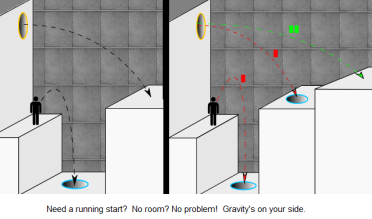
flinging

All the while, your efforts are being assessed and snarkily commented on by GLaDOS, (‘Genetic Lifeform and Disk Operating System’, a homage to MS-DOS), an AI built by the creators of the Aperture Science labs. We find out during the course of the tests that GLaDOS turned on the scientists of Aperture, releasing a deadly neurotoxin that has wiped them all out. So far, so psychotic femme-voiced killer AI.

GLaDOS’ passive-aggressive comments on your progress, and on your pathetic humanity, also come with promises of a reward at the end of the testing process: a cake. Although, we also see graffiti from a lab worker, Doug Rattmann (the ‘Lab Rat’) warning that the cake is a lie.
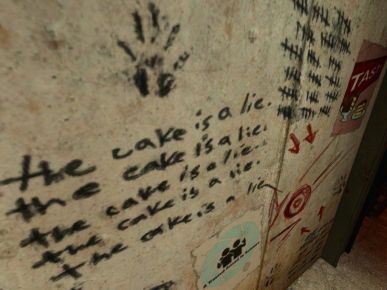
cake

We defeat GLaDOS at the end of Portal 1, ending up lying on the ground outside the facility gates, surrounded by the remains of the AI. But with the release of Portal 2, the original ending was retconned to show Chell being dragged away, back into the facility, with a robotic voice thanking her for lying on the floor and assuming the “party escort submission position”. GLaDOS then sings over the credits, letting us know that she’s Still Alive. She does indeed return in Portal 2, with even more test-rooms. For science.

I don’t think it’s a complete coincidence that we downloaded Portal 2 now, just as a whole generation in the UK have been tested and are now receiving their results, either for their Scottish Highers, A-Levels, and soon Scottish National 5 qualifications and GCSEs. Just as we’ve been watching an AI guiding, and lying to, a test subject, around 280,000 A-level students have had their grades adjusted downwards by an algorithm. Others have written detailed explanations of where this decision-making system has gone wrong, not only in its mathematical standardizations but also in how it makes assumptions about this school year on the basis of previous years. Go to an already high-attaining (likely Private or Public school) and the algorithm marks you upwards. Go to a school with a history of lower grades and there’s no way you could really deserve that A you were predicted. They’ve played the game, been promised cake at the end of it if they work hard enough. But the cake was a lie.

And they are angry.

I’ve written elsewhere about what happens when we trust ‘the algorithm’ too much; when we hand over so much of our agency that it becomes something we see as holding sway over our fate. So much so that we can feel that we have been ‘Blessed by the Algorithm’. Theistic metaphors hold true here too: I imagine many of these students currently feel ‘Cursed by the Algorithm’ as opportunities they have worked so hard from vanish from view. While our governments may make more of those u-turns that they are becoming infamous for (Scotland has already said universities should accept non-adjusted grades), at the moment we have a clear example of too must trust in a bad system, as well as the suggestion that any system we placed so much trust in might be bad for us.

There are of course differences between GLaDOS and the code put together by Ofqual, the exams regulator, that has created this current mess. Like so many other science-fiction AIs, GLaDOS is credited with personality, intention, and even cruelty. However, our tendency to anthropomorphize even the most abstract of mathematically driven decision making systems means students end up shouting ‘fuck the algorithm’, as though personally hurt by this string of code. They’re also shouting at Boris and his cronies of course, but there’s a danger in slipping into anthropomorphic thinking when it comes to the systems that are being used by actual humans in power to make decisions about our futures.

The creators of Portal leant into this anthropomorphism to make GLaDOS a villain. Early on in development, they also realised that one particular test required anthropomorphism to make it work for the gamer. In a ‘box marathon’ test, the player has to get from one side of a difficult test room to the other while carrying a cube. At first, players kept forgetting the box and leaving it behind. Then one of the game’s creators, having read some “declassified government interrogation thing” whereby “isolation leads subjects to begin to attach to inanimate objects”, suggested making the cube ‘cute’. They added a pink heart to its design, called it the Companion Cube, and gave GLaDOS some lines about how it was unlikely that the cube was sentient – at least, it probably wasn’t. Then, at the end of the box marathon test, the player has to learn how to use an incineration device – in order to defeat GLaDOS later on – and has to burn up the Companion Cube:

“Although the euthanizing process is remarkably painful, eight out of ten Aperture Science engineers believe that the Companion Cube is most likely incapable of feeling much pain.” – GLaDOS

The player’s connection makes this moment actually affective. But, as the Michael Rosen poem above suggests, the dangers of handing over agency to algorithms are not just in reifying, or deifying, them but also in the counter-reaction: reducing those we enter into the system to being ‘just’ data. This is Goodhart’s Law and then some: ‘When a measure becomes a target, it ceases to be a good measure’. And when a student becomes something to be measured against, becomes data – your school has produced U-class A level students, therefore you must be a U-class student – the individual is lost in the algorithm.

Reifying and anthropomorphising the algorithm obviously obscures the humans – the students in this case – inputted into the system. It also obscures the humans behind the system. At the moment, students are trying to hold people in power to account, protesting outside the Department for Education in London. But it’s increasingly obvious that a certain flavour of technological accelerationism is gaining ground in the policy thinking of the UK government, signified by the adoption of the ‘move fast and break things’ thinking of Silicon Valley. The Barnard Castle fan, and Chief Advisor to the PM, Dominic Cummings has become the poster boy for this kind of approach, but he wouldn’t be so successful if there weren’t others who agreed with him.

When this kind of thinking clashes with the realities of people’s lived lives we’ll get these moments of rebellion against the algorithm, of Chell facing off against GLaDOS. But unless light is shed on the more insidious moments when algorithms are trusted too much by the government we might not know all the times when the cake is a lie.

Some tech ethicists calling for more transparency are trying to find a middle-way between ‘fuck the algorithm’ and ‘assume the party escort submission position’. I’m always a little wary of including myself in this endeavour, as the banner of ‘ethics’ is increasingly being used – by corporations in particular – to obscure these very problems. They can’t be unethical, they have an ethics board! But we can all get involved in bringing light to issues. For instance, some, like journalist Carole Cadwalladr below, have pointed out the irony of Roger Taylor being the chair of both Ofqual and the Centre for Data Ethics and Innovation in the UK (tasked with ensuring algorithmic fairness).


(As I write this (at 2.56pm) there are reports that he will make a statement at 4pm, likely announcing a Scottish-like u-turn. We shall see).

(Hi, its 4.03pm Beth here, yes we have a u-turn! Thoughts with all the admissions offices who now have to deal with this revision when there’s a cap on places!!)

The Portal games are challenging mind-bending, puzzles with amusing representations of AI and robots (and the co-op version lets you play as a part of robots who are always being blown up, which is more fun than it sounds) but for all that GLaDOS guides Chell in them, they are not a guide for life. It’s a few years until my small human needs to worry about exams, but already he’s in a system that will regularly test and grade him like Chell. So I’ll need to teach him about the algorithms that promise you cake in the real world and the humans who wrote the lie in the first place. Portal seems a good place to start…
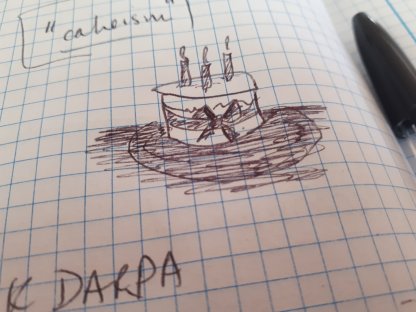
cake pic
You got to the end so here is the cake: a doodle I drew while writing my notes for this post 🙂

‘How to Talk to Robots: A Girl’s Guide to a Future Dominated by AI’ by Tabitha Goldstraub

I’m very excited about the forthcoming book by Tabitha Goldstraub, How to Talk to Robots: A Girl’s Guide To a Future Dominated by AI.

Goldstraub

The book involves interviews with women working in, and thinking about, AI (including me!). Fantastic portraits of all the interviewees were drawn by the wonderful Jess Wade (also interviewed in the book):

Beth Singler Jess Wade
It’s me!

Pre-order the book now for its October 2020 release 😀

NEW PAPER: “Blessed by the algorithm”: Theistic conceptions of artificial intelligence in online discourse

Blessed by the Algorithm Paper B Singler 2020

“My first long haul flight that didn’t fill up and an empty row for me. I have been blessed by the algorithm”

The phrase ‘blessed by the algorithm’ expresses the feeling of having been fortunate in what appears on your feed on various social media platforms, or in the success or virality of your content as a creator, or in what gig economy jobs you are offered. However, we cblessed 2an also place it within wider public discourse employing theistic conceptions of AI. Building on anthropological fieldwork into the ‘entanglements of AI and Religion’ (Singler 2017a), this article will explore how ‘blessed by the algorithm’ tweets are indicative of the impact of theistic AI narratives: modes of thinking about AI in an implicitly religious way. This thinking also represents continuities that push back against the secularisation thesis and other grand narratives of disenchantment that claim secularity occurs because of technological and intellectual progress. This article will also explore new religious movements, where theistic conceptions of AI entangle technological aspirations with religious ones.

AI & Society, April 2020

NEW PAPER: The AI Creation Meme: A Case Study of the New Visibility of Religion in Artificial Intelligence Discourse

The AI Creation Meme A Case Study of the New Visibility of Religion in Artificial Intelligence Discourse

Through a consideration of examples of the AI Creation Meme, a remix of Michelangelo’s Creazione di Adamo featuring a human hand and a machine hand nearly touching, fingertip to fingertip, this article will tackle the religious continuities and resonances that still emerge in AI discourse in an allegedly ‘secular age’. Examples of AI Creation MemeThe AI Creation Meme, as a highly visible cultural artefact appearing in a variety of forms and locations, will be analyzed and discussed for its religious, apocalyptic, and post-humanist narratives, along with reference to earlier work on the New Visibility of Religion—specifically, Alexander Darius Ornella’s consideration of the New Visibility of Religion and religious imagery of the 2006 film, Children of Men. Work that outlines the aspects of critical post-humanism, speculative post-humanism, and transhumanism in relation to the contemporary post-secular age will also be addressed to expand on the implicit apocalyptic messages of the AI Creation Meme. Such a consideration of repeating and remixed imagery will add to the scholarly conversation around AI narratives and the entanglements of religion and technology in our imaginaries of the future.

Religions 2020, 11(5), 253

Say Hello to DoctorBethBot :)

I am extraordinarily excited to have just won @Smolrobots 12,000 follower give away! The prize was a personalised robot of my very own and a signed copy of their wonderful first book of Small Robots.

Please say hello to DoctorBethbot, a botthropologist 🙂


Et In Silicon Valley Ego

This post will include spoilers for Devs, a new television series by Alex Garland (2020) and for Tom Stoppard’s play Arcadia (1993). Although, really, you should have had plenty of time to catch the latter by now… Anyway, spoilers ahead.

.

Seriously, spoilers. You have been warned.

.

You should turn back now if you haven’t seen Devs and Arcadia.

.

Seriously, you can turn back now…

.

And the fact that you can turn back is actually significant [spoilers start from here].

Because you can, if you choose to, turn back here. You are able to. You can click back on your browser, and reverse the flow of time in a metaphorical, if not a literal, way. Here, at this moment, you can go backwards. At this moment, you CAN stir the jam back out of the rice pudding…

“When you stir your rice pudding, Septimus, the spoonful of jam spreads itself round making red trails like the picture of a meteor in my astronomical atlas. But if you stir backwards, the jam will not come together again. Indeed, the pudding does not notice and continues to turn pink just as before. Do you think this is odd?” – Thomasina, Arcadia

rice puddding

I’ll get back to Thomasina’s observation in a moment.

I recently finished binge-watching Devs by Alex Garland. As television series go, I’m not sure that Mr Garland could have created a story that was more up my street than this one. Yes, like almost all the other AI thinkers, researchers and technologists I’ve ever met, I’ve seen Ex Machina. But to be honest, I probably liked it more for its take on Silicon Valley bro-preneurs and bro-tagonism than for what it said about the probability and nature of AI consciousness. And some of the male-gaze moments felt more like having your cake and eating it than critique to me. Although, the alternative ending where we got Ava’s non-human POV always appealed. Annihilation scratched a few bio-horror and posthumanism itches and gave me strong female scientists, and gets a thumbs up from me. So, I was interested to see what was coming next from this writer/director…

Devs, though.

wow
Me on Devs

Not only Silicon Valley culture but also Simulation Theory, computational universes, determinism, multiverse theory, and all replete with religious imagery and narratives. Because of this near-perfect mix of favourite Beth-things, I’m going to forgive rather the on-the-nose last episode twist of the V in Devs being a roman numeral making it actually the U in Deus. Computers as god(s) isn’t a new story, and I’ve spent a lot of time writing about theistic conceptions of AI. But AI wasn’t really the focus here. It was more about the human characters than the tech in the end. In fact, the first episode took us quickly from AI to Quantum Computing as one of the key characters was promoted from the former to the ultra-secretive DEVS, indicating that this wasn’t Ex Machina 2.0, even if we finally got the ‘Deus’ part of that old expression.

Even the lovely shiny golden Quantum Computer in the floating box under the ground surrounded by a vacuum (how DID the toilets work???) wasn’t much more than a McGuffin for a very human story about fate, free will, and sadness. Yes, the story wouldn’t have happened without the computational power of this near-mythical golden device; resplendent in shining doodahs, tubes, and wires, and with a pulsing heartbeat that shone and shimmered around the underground cube. Deus was able to crunch such impossibly large amounts of data – all the data in our universe in fact – that both the past and the future could be predicted and projected visually on a screen. Seeing a static blurred Jesus on the screen in the Devs team’s red screening room in the floating box was a powerful moment, even for a non-believer. Hearing him speaking in Aramaic was genuinely spooky. But Devs had bigger aims than dealing with the implications of finally proving the historical existence of Jesus.

Because, seconds later, in a heart-rending moment of crushed dreams, the developer, Lyndon, who had finally managed to fix the white static fuzziness and produce crystal clear audio of those last words, was fired. He had introduced Hugh Everett’s Many Worlds Interpretation into the Quantum Computer’s prediction algorithm. Forest, the head of Dev’s parent company Amaya, had banned Many Worlds theory because he was dedicated to a deterministic view of a single universe rather than the branching possibilities of many universes as described by Everett. Introducing multiple worlds meant that they might not be predicting their Jesus, for example, but one who might be from another universe. Different perhaps by only by a single hair on his head, but just not the same one.

But it wasn’t Jesus that Forest was interested in. And given his later comments about the Messiah complexes of Silicon Valley genius we might be mistaken in thinking he was feeling competitive. In fact, Forest, who had lost his wife and daughter, Amaya, in a terrible car crash, did not want to simulate an Amaya who was not his Amaya. Even if the difference was as small as a single hair on her head. Even though Lyndon’s adjustment made it possible for him to see her again, not just as a blurred figure behind white snow, but in high definition. But eventually, we saw him watch, enraptured, by a completely perfect simulation of a past her, existing in the Devs computer after his number 2, Kate, also implemented Lyndon’s algorithm to the video outputs.  

But what does all this have to do with jam and rice pudding?

After finishing Devs, I was thinking about Arcadia and its similarities and differences with Devs. I don’t think Alex Garland was directly inspired by Stoppard’s play, and on the face of it, the play has very little to do with Silicon Valley. But thinking about the two stories together might be fruitful.

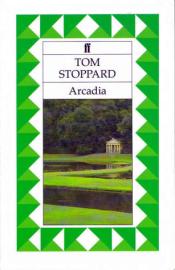
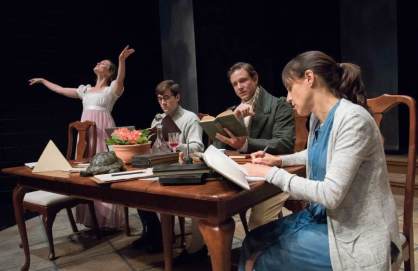
Arcadia 2Arcadia pic

Arcadia is set in Sidley Park, a great estate in Derbyshire, and during the course of the play, two apparently separate moments in time take their turn to play out on the stage before eventually overlapping with each other.

In 1809, we see Septimus Hodge tutoring Lady Thomasina Coverley, a teenage mathematical prodigy and the daughter of the Lord and Lady of the house. In the present day, academic Hannah Jarvis is researching a history of the house and its garden. She is using a hermit who lived in the faux-hermitage that was built on the grounds in the early 1800s as the thematic lynchpin for her next book on the Romantic imagination. Her work is interrupted by Bernard Nightingale, a historian working on Lord Byron. Byron was a school friend of Septimus’, and Nightingale believes he may have fought a duel while visiting Sidley Park and killed Ezra Chater, a rather lacklustre poet. Valentine Coverley, the current heir to the house, is using the house’s ‘game books’ (the records of hunting parties’ catches) to crunch numbers for his research into grouse population changes. All three are looking for data to give them insights into the past. But we, the audience, get to see the misunderstandings the academic are falling into as they try to ‘predict’ the past based on the limited data that they come across during the course of the play. For instance, Chater was not killed by Byron. Nightingale, arrogant and sure of his headline-worthy discovery, is blind to the later historical records that mention an ‘E. Chater’ as a botanist because that past doesn’t fit his view of what happened at Sidley Park. In many ways, this group of modern academics are seeing the past in the same static filled way as the Devs team are at the beginning of the series. Back when they are limited to the determinism of one predictable, deterministic, universe.

Arcadia is also a story filled with determinism and despair, just like Devs. In the very first scene, Thomasina is certain that she has had a mathematical revelation:

“If you could stop every atom in its position and direction, and if your mind could comprehend all the actions thus suspended, then if you were really, really good at algebra you could write the formula for all the future; and although nobody can be so clever to do it, the formula must exist just as if one could.” – Thomasina, Arcadia

Of course, Thomasina has only the barest inkling of the kinds of universal difference and analytical engines that were coming. Quantum Computing would also be far beyond the Newtonian physics her calculations were assuming. Squaring the circle of quantum methods and Newtonian predictions in Devs seems to have only been possible through Everett. So again, this leap was certainly beyond Thomasina’s brilliant, but too early, mind.

In this scene, she and Septimus go on to discuss free will, with Thomasina concluding that god must be a Newtonian (delightfully/intentionally misheard by Septimus as “an Etonian”). However, as with the rice pudding and the jam, she’s also realised the big problem of Newtonian determinism. Knowing the ‘tramlines’ (as Forest refers to them in Devs), the direction of travel, does nothing to stop the bad things from happening and they cannot be undone. The jam cannot be unstirred from the rice pudding. Entropy cannot be combated. The heat death of the universe is inevitable. Everything is lost eventually. Even Thomasina herself.

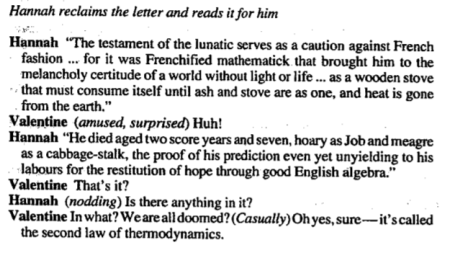
There is an undefeatable fate that also awaits her ahead on the tramlines. We learn from Hannah and Valentine in the present day that Lady Thomasina Coverley died in a fire the night before her seventeenth birthday. Just moments later, we watch her dance with Septimus on that fateful night, as Hannah and Valentine discuss the mysterious figure of the hermit who hid himself away in the fake-ancient hermitage in the gardens. The Genius of the Place, as Hannah’s book will eventually be called, using both meanings of the expression. The genius of the place was a man who spent the rest of his life attempting to disprove the second law of dynamics that Thomasina had stumbled upon forty years early, in order to return back down the path he had already trodden. To remove the jam from the rice pudding. And perhaps, like Forest, to bring back a lost one:

The Hermit

Septimus, as the hermit Paulus, hoped to use good English algebra to turn back time. Septimus was unsuccessful. Thomasina was gone forever.

However… the play offers us a simulation of the past. Thomasina dances again as the past is replayed simultaneously with the present inhabited by the academics. The play also explores Chaos Theory (more prominent in the 1990s and replaced in favour by more quantum theories now), and the way in which the objects from the past (important clues and pieces of data) are left on the table by the 1809 characters evokes increasing entropy and chaos.

Forest, as the head of Amaya, hopes to use good Quantum Computing (not American Quantum Computing, he’s quite clear he sees nations and states as hindrances to his work) to turn back time. Forest is successful. Amaya is back (forever?).

The series ends after the death of Forest and Lily and their resurrection in the Simulated Universe Forest has created inside Devs/Deus. Up until this point, I haven’t discussed Lily’s role very much. She is the main protagonist, and her actions lead to a point of uncertainty that the algorithms can’t see beyond; a point with no. That point turns out to be a moment of actual free will, as Lily refuses to kill Forest as was predicted by Devs. Even so, she and Forest still die and are then resurrected in the Simulated Universe. For all the uncertainty Lily introduces to the deterministic system, she still proves Forest’s personal prediction right. She tells him, “The problem with people who run tech companies is that they’re fanatics. They end up thinking they’re messiahs”. He responds to this in the Devs simulated scenario of their deaths, first telling her that Devs is actually Deus, and that the thing about Messiahs is that they get resurrected.

Of course, since Lyndon, the system has been ‘infected’ with multiverse theory. So, in effect, Lily’s decision not to kill Forest spins off a whole new universe. Hence Devs not being able to see beyond that point of choice. However, this new universe is a Simulated Universe, inside Devs itself. It’s a nice one, as Forest points out to the confused Lily newly discovering their world. Its more heaven than hell, certainly. Amaya and Forest’s wife are back. As are other characters who died during the series. It is a paradise.

Or we might see the new universe not as paradise or heaven, but as the world beyond the Garden of Eden. Kate refers to Lily as having committed the ‘Original Sin’ in making her choice not to kill Forest. By which she meant that Lily had acted in a moment of complete free will, just as Adam and Eve did in the Garden in the Old Testament. However, instead of being ejected from the Garden of Eden and ending up somewhere worse, Lily and Forest are resurrected after her choice in somewhere much more utopian.

However, Et in Acadian Ego. “Even in Arcadia, there am I”.

Arcadia 3

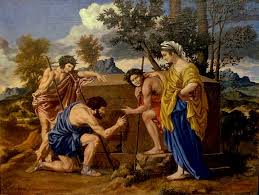
This is the title to a 1637 painting by Nicolas Poussin. It shows four shepherds in a beautiful, idealised, pastoral scene. They are examining a tomb: a reminder of death, even in life. Even arcadia – paradise, utopia, etc – contains death. Initially, Tom Stoppard named his play Et in Arcadia Ego, before shortening it to just Arcadia. The entropy and chaos that Thomasina predicts and that Septimus spends his life trying to refute is also in the paradise of Sidley Park and its romantically renovated gardens, hermitage and all. Thomasina’s death proves that. But is death also in the Simulated Arcadia that Forest and Lily end up in?

One strangeness in the series Devs is that Lily, a computer programmer based in Silicon Valley, seems to have no awareness of Simulation Theory or computational theories of the universe (or even determinism at one point). It was a little like those moments in Zombie movies when the main characters are faced with a shambling undead being that bites humans and is susceptible to a headshot but can’t bring themselves to say the ‘Z’ word. As the audience’s stand-in, Lily might be forgiven for this, we need a fair bit of exposition to follow the plot. But Forest really should have known that the universe he was simulating inside Devs might be open to entropy and death. It would be there either through the breakdown of the physical set up in the ‘base reality’ of the original Devs building and Amaya as an organisation. Or, entropy might leak in through the original data itself, as ‘Et in Terra ego’. And of course, the Simulated Universe could not be entered without Forest and Lily dying in the first place. Another programmer character Stewart, recites Philip Larkin’s poem Aubade (mistaken by Kate for Shakespeare, and proving for Stewart that the people creating the future know nothing about the past), a poem also about the inevitability of death. Even religion, “That vast moth-eaten musical brocade created to pretend we never die” (Larkin), cannot help us to escape that inevitable. Even Devs, a new religion writ in golden temple and halo-ed trees and complete with its own Messiah, can’t either.* And it is notable that it is Stewart who kills Lily and Forest.

But there is also the argument that mind-uploading (in this case, even the most perfect mapping of all the possible data of a person) and virtual resurrection could never recreate the same person anyway. So even if Forest and Lily had not died, they died the very moment they were uploaded.

The religious narratives were ever-present in Devs, and very cleverly explored. Forest and Devs were both compared to gods/messiahs, and Lily was compared to Adam and Eve in making the first-ever completely free choice. Arguably, that moment of choice was more divine than human, as Lily’s choice led to the creation of an entirely new universe.

But then, if Everett was right, we’re all gods making new universes, with every choice we make.

DEVS -- Pictured: Nick Offerman as Forest. CR: Miya Mizuno/FX

* thanks to @huwcdavies of the Oxford Internet Institute for discussing this blog post with me and making me think further on the significance of the Larkin poem 🙂