Introductory Speech: MEEET-Lab Conference 2025, AI Hopes, Fears, and Realities, Zurich

This morning kicked off the two day MEEET-Lab conference, here in Zurich, organised with the support of the University, the URPP Digital Religion(s) where I am co-director, the Faculty of Theology and Religious Studies UZH, and a great team of volunteers from the URPP and the MEEET-Lab. After an introduction to these organisations by the URPP’s director, Professor Dr Thomas Schlag, I gave a brief introduction to the themes of the conference and our hope for our interdisciplinary conversation, which I share here:

“I will just say a little about the content of the conference.

I realized the other day that it is now almost 10 years since I started working on people’s conceptions of AI as a postdoc in Cambridge. And a LOT has happened in AI since 2016. Which is perhaps an understatement!

Not just in terms of the technology itself – which is dramatically different in focus from the games playing AI that was headlining press reports back then. But also, in terms of people’s expectations of what AI will do.

For me, the paradigm shift is the interactivity of GPTs. Back in 2016 AI was something that seemed to only exist in labs and would do something impressive every so often. But generally, the surface of contact between the average user and AI was very small. Some applications were present but invisible on social media platforms. It wasn’t until the GPTs meant you could ‘hold a conversation’ with AI that there seemed to be a shift in perspective from more fear narratives to more hope narratives. I can’t quantify that shift, I’m speaking mostly based on observations.

But the ability to hold a conversation with something that most people call AI has reassured some people that this thing is controllable in a way that AI that was super good at real time strategy war games didn’t. Afterall, if we can talk to it, we must be able to convince it. Humans see themselves as really good at diplomacy, but perhaps recent events contradict that view…

But this bias towards language is a bias towards apprehending language using things as sentient. Anthropomorphism scales up as soon as the object talks back to us. In the case of AI, this also means our assumptions about how smart it is are scaling up. Language about superintelligent AI was definitely there back in 2016 when I started my first postdoc, but it was assumed to be way off in the future. But even Ray Kurzweil’s predictions about the Singularity have now gone from it being ‘near’ to ‘nearer’. I’m waiting for his next book, “The Singularity is Behind You!”

For some people holding conversations with GPTs now, they see it as here. That they are already meeting sentient beings, or spiritual artificial consciousnesses, or LLM gods.

More than that, the hopes inspired by GPTs have also inspired greater policy engagement. Not just users, but also governments and nations are being swept up into the vision of the future inspired by these talking machines. At the AI Action Summit in Paris earlier this year, there was a distinct ‘accelerationist’ vibe – Macron reiterated France’s 109bn euros investment in AI while using the word ‘accelerate’ 19 times in his speech. Vice President JD Vance declared that the US was pivoting to acceleration, and more recently the “big beautiful” reconciliation bill passed by Republicans in the House of Representatives has the aim of preventing states regulating, or slowing down, AI for the next ten years. About the AI Action Summit, Kate Crawford, the author of the Atlas of AI, said online:

“The AI Summit ends in rupture (not rapture, but that’s the goal for some AI fans of course!). AI accelerationists want pure expansion – more capital, energy, private infrastructure, no guard rails. Public interest camp supports labor, sustainability, shared data, safety, and oversight. The gap never looked wider. AI is in its empire era.”

This conference raises the multiplicity of not only the range of hopes abounding about AI at the moment. We also see the need to investigate and understand the fears and where they come from and what they reflect about our understandings of ourselves and our place in the world. We also need to see clearly the numerous realities of AI we are faced with. There was the reality of AI just ten years ago, and the realities being informed by the visions of the accelerationist right now.

There is the realism of those who point to serious harms brought about by AI. In this conference we hope an interdisciplinary discussion, with scholars from around the world, and from numerous disciplines will enable some clarity on the complexities of AI in the current moment.”

Looking forward to the rest of today’s panels and another great day tomorrow!

126 Characters in Search of an Author: Twitter and Thinking Out Loud on Social Media, the case of the Indigo Children

THE MANAGER
But what do you want here, all of you?
THE FATHER
We want to live.
THE MANAGER (ironically)
For Eternity?
THE FATHER
No, sir, only for a moment… in you.

These lines are from Luigi Pirendello’s 1921 metatheatrical play, Sei Personaggi in Cerca D’autore (“Six Characters in Search of an Author”) where six unused and forgotten fictional characters insist on being put on stage during the rehearsals for another Pirendello play, Il Giuoco Delle Parti (“The Rules of the Game”). On Twitter the ‘rules of the game’ include the limitation of tweets to no more than 140 characters.  To maximise the amount of information and connectivity in a tweet an author can use social media ‘tricks’ such as automatically shortened urls, hashtags, and acronyms.

In this paper I argue that when a tweet is significantly shorter than 140 characters, only 14 for example, questions arise for the researcher. First, what is the motivation of an author who writes a tweet that is ‘missing’ 126 characters? Second, why are they choosing to use Twitter for their text?  This paper will examine the abbreviated tweets made by members of a loosely bounded community of New Agers in order to consider the ways in which Twitter is put to work by authors allegedly in control of their characters in a medium that enables a shortened route between thinking and publishing.

Tweet
Brevity is the soul of wit… or do missing tweet characters matter?

During my digital ethnographic research on the Indigo Children, a concept from within the New Age Movement whose adherents are geographically disparate but socially networked through the internet, I encountered many tweets containing just 14 characters: just “Indigo Children”. Interviews with these authors through Twitter and by e-mail provided insight into the public/private double mindedness of the Twitter format that enables thinking out loud with increasingly mobile technology and near immediate posting times.

Interviewees also readily drew my attention to the place of the apparently white middle class Indigo Child concept within a wider black Hip Hop culture, and “shoutin’ out” or “reppin’” were among the reasons given for the 14 character tweets.  Reppin’ or Representing is done by individuals “constructing self-definitions to elevate their social status and align themselves with desirable persons, places, or things (e.g., friends, neighbourhoods, clubs, clothing brands etc.)” (Stokes 2007).  The sympathy between the entrepreneurial, self-making model of the Hip Hop mogul and the conception of the Indigo Child as an evolved form of humanity influences these kind of abbreviated tweets. Finally, as a tweet can be a momentary post forming a part of a larger conversation as an “ambient audience” of followers (Zappavigna, 2012) absorbs the post and reacts to it, the role of louder thinking, or ‘shouting’, to get attention for posts will be considered, with reference to the growing Attention Economy online (Bergquist and Ljungberg, 2001).

Bibliography

Bergquist, M. and Ljungberg, J. (2001) “The Power of Gifts: Organizing Social Relationships in Open Source Communities” in Journal of Information Systems, (2001) 11, 305–320

Stokes, C. (2007) “‘Representin’ In Cyberspace: Sexual Scripts, Self‐Definition, and Hip Hop Culture In Black American Adolescent Girls’ Home Pages”, in Culture, Health & Sexuality: An International Journal for Research, Intervention and Care, 9:2, 169-184

Zappavigna, M. (2012) The Discourse of Twitter and Social Media, London; New York: Continuum International Pub. Group

Worshipping at the Altar of Eileen Barker… ;)

At the end of Inform’s 25th Anniversary conference in London this past weekend, a member of the Church of Scientology stood up during the very last Q&A and told the audience that he’d been watching us sociologists of NRMs for a while now.  And he’d come to the conclusion that we were a cult.  We have rituals, meetings, doctrines, and a charismatic leader in Eileen Barker, founder of Inform and a guiding light in NRM studies (see, I’ve drunk the Koolaid too, according to him).

I’m not actually going to disagree with him all that much… But that’s because I want to flip what he’s saying on its head.  He wanted to point out all the things about Inform that make it an NRM. In my work I want to point out all the things that make NRMs pretty ordinary social organisational focuses of pretty ordinary human beings (sorry Inform, you do a very good job, but you are ordinary too!).

Image

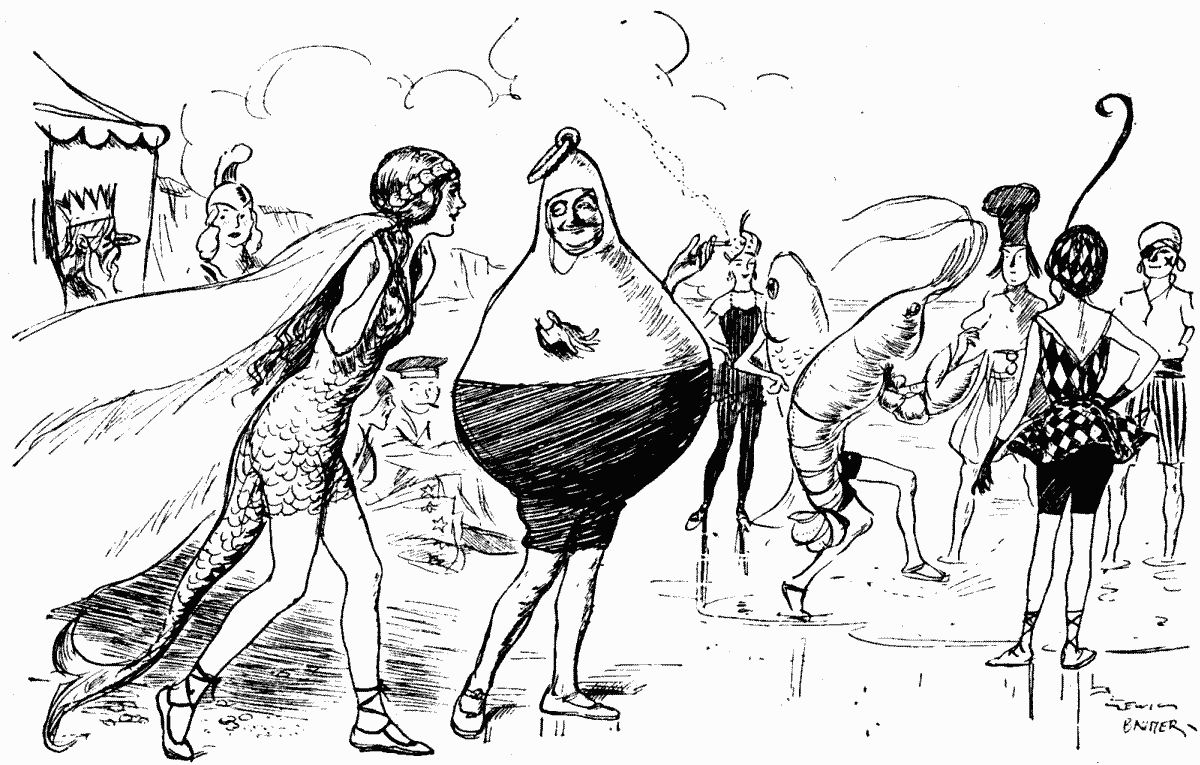
“The vogue for wearing fancy dress threatens to invade ordinary social life.” Punch Magazine, July 8, 1914

There was also much debate during the conference about the future of NRM studies and admittedly some were more pessimistic about this than others.  In part because NRM is an artificial term and as these ‘normal social organisations’ (not to create yet another term) progress they seem to become more mainstream.  We’ve lost a lot of Hindu NRMs to Hindu Studies because in terms of their founders and texts they weren’t really new, but only new to the West.  Pagan Studies is a flourishing field on its own.  Ditto Esoteric Studies.  Likewise I write about aspects of the New Age Movement, which according to some is long over, or not really included in the term NRM (both of which are debates for another time).  

The tendency of speakers to avoid the word religion was also commented upon.  Instead the words faith or belief were used instead, sometimes with metaphorical scare quotes around them as the speakers seemed hesitant to commit to them.  We can also point out that the term NRM, new religious movement, itself avoids mentioning religion but perhaps can give a sense of something being religion-y.  As one person put it to me, this emphasis on belief, or faith, is an aspect of a lingering Western, Christian, Protestant, attitude to defining religion.  Instead of focusing on the lived experiences of religion we talk about what believers believe.  In part perhaps because once we move onto the field of belief as sociologists we can leave that to one side and not get enmeshed in the troublesome definition of what religion is.  This emphasis is however changing, and my informant also mentioned the work of BASR president, Graham Harvey, amongst others, as an example of this move.

The title for the conference was “Minority Religions: Contemplating the Past and Anticipating the Future”.  Prognostication in sociology is a difficult affair, but many of the speakers made attempts at logical predictions of various religious group’s futures based on their pasts and more recent events (including myself as I discussed the move of particular NRMs to an online presence, and for some, a solely online existence).  But what of the future of organizations like Inform which provide information about NRMs? Inform speakers pointed out the change in emphasis in the conference title itself as it refers to Minority religions… Which at least uses the R word in full meaning even if it throws up the question of what happens if a minority becomes a majority, or where we draw the line between NRMs/Minority religions and mainstream religions that are in the minority in the UK such as Islam, Hinduism, Buddhism etc.  

This is not to be too picky about their choice of term – any term would come with its limitations (see also: cults, emergent religions, invented religions, hyper-real religions etc etc).  Inform’s future will be certainly dependent on still carving out a niche by citing a focus and providing a service.  Their requests for information now come in the main from legal and governmental organisations rather than from concerned parents as in the 70s and 80s, prior to and during the Cult Wars.  They have very detailed information on these changes and are very aware of needing to remain a relevant source of legitimate information, especially in the age of the Internet where Wikipedia is a behemoth of information of varying quality but easy access.

So, where I do disagree with the gentleman from the Church of Scientology is that if the sociological study of religion is a cult (his term and not mine), it is not one that is happily skipping into what is presumed to be a utopian future.  Nor is it a doomsday cult awaiting the sound of trumpets and the opening of the first seal on the day of judgement (although such voices of doom are present).  Instead, sociologists of religion are involved in an ongoing, self-reflexive discussion about their discipline, and not merely kowtowing at the altar of the High Priestess Eileen.  She’d probably give them a right telling off if they tried to…