I just submitted the final drafts of my new religion and AI book… so now there are just the reviews, new edits, copy-edits, proofing, indexing…
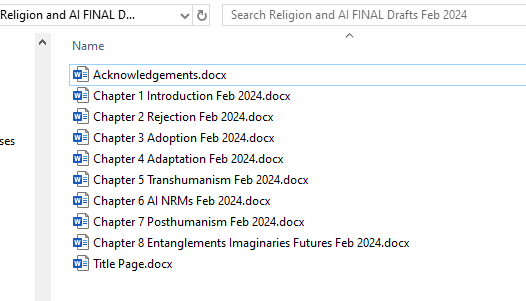
I just submitted the final drafts of my new religion and AI book… so now there are just the reviews, new edits, copy-edits, proofing, indexing…
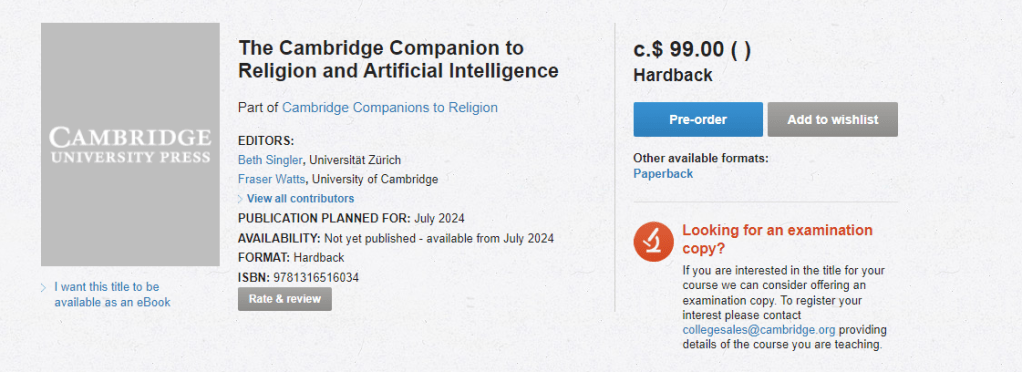
“Religion and artificial intelligence are now deeply enmeshed in humanity’s collective imagination, narratives, institutions, and aspirations. Their growing entanglement also runs counter to several dominant narratives that engage with long-standing historical discussions regarding the relationship between the ‘sacred” and the ‘secular’ – technology and science. This Cambridge Companion explores the fields of Religion and AI comprehensively and provides an authoritative guide to their symbiotic relationship. It examines established topics, such as transhumanism, together with new and emerging fields, notably, computer simulations of religion. Specific chapters are devoted to Judaism, Christianity, Islam, Hinduism, and Buddhism, while others demonstrate that entanglements between religion and AI are not always encapsulated through such a paradigm. Collectively, the volume addresses issues that AI raises for religions, and contributions that AI has made to religious studies, especially the conceptual and philosophical issues inherent in the concept of an intelligent machine, and social-cultural work on attitudes to AI and its impact on contemporary life. The diverse perspectives in this Companion demonstrate how all religions are now interacting with artificial intelligence.”
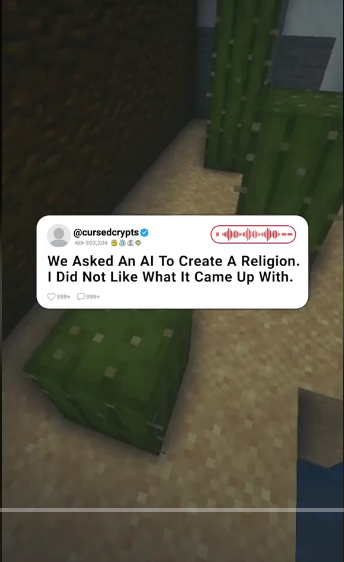
My new article is out now! “‘Will AI Create A Religion?’: Views of the Algorithmic Forms of the Religious Life in Popular Discourse”
At the Journal of American Religion, alongside some other great articles on religion and AI for a special issue https://muse.jhu.edu/article/916424
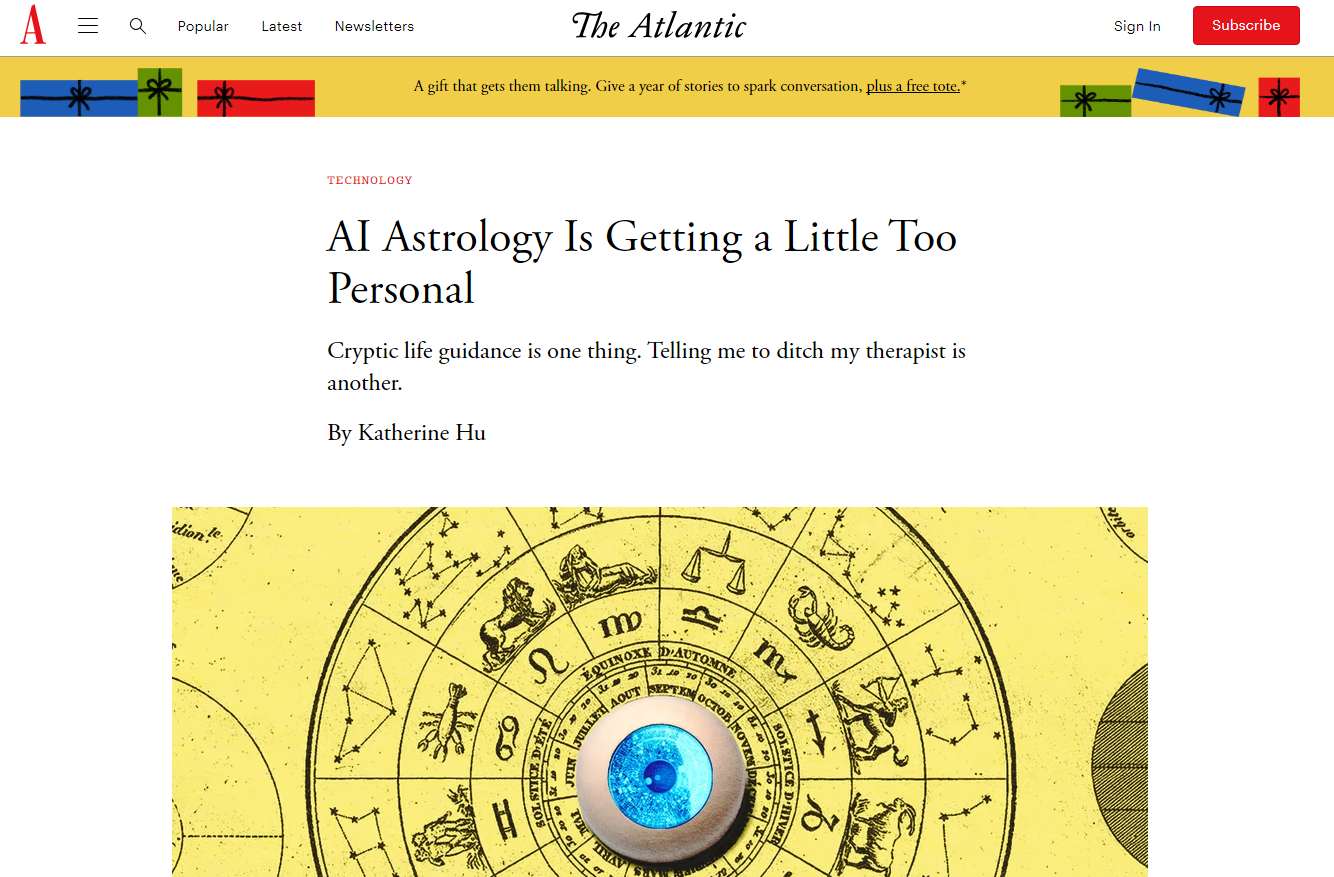
A fantastic new piece by Katherine Hu at the Atlantic on AI being used in astrology and divination that I was interviewed for 🙂
AI Astrology Is Getting a Little Too Personal
Okay, a little kind of super SUPER excited. The publication of a special issue dedicated to MY research:
“In times marked by the digital revolution and the development of machine learning, there is nothing more relevant than discussing the impact of Artificial Intelligence on religion: are algorithms the gods of today? The article, “Blessed by the Algorithm: Theistic Conceptions” by British anthropologist Beth Singler, Professor in Digital Religions at the University of Zurich in Switzerland, investigates religious perceptions of Artificial Intelligence by exploring the expression “blessed by the algorithm” in digital discourses and posts. The article not only maps the ways in which individuals believe they are “blessed by the algorithm”, but also questions the grand narratives linking secularization and disenchantment with technological progress. This text, one of the first published exploring the relationship between religion and artificial intelligence, prompted comments from foreign and Brazilian colleagues. Contributors to this debate included Carly Machado (Federal Rural University of Rio de Janeiro), Giulia Evolvi (Erasmus University Rotterdam in the Netherlands), Jacob Boss (Indiana University in the United States), Marta Kołodziejska (University of Warsaw in Poland).”
NER Debates: Digital Life and Religion, Debate – Blessed by the Algorithm
In this edited volume, we will explore the intersection of religion and emerging technology. Our contributors – scholars of religion, theology, sociology, anthropology, history, STS, and science fiction studies, and others – will theorize the way people use emerging technologies in their spiritual, religious, and embodied practices. They will also consider how emerging technologies themselves express and frame new ways of seeing and being in the world: how are such technologies fostering new life worlds, eschatologies, and cosmologies? What meaning making is happening in the employment of such tools, and how are such tools drawn into existing maps of meaning and wonder?
Further, in this volume our contributors will investigate the ways in which technology can challenge or contribute to human flourishing, and the discovery of significance, while simultaneously grappling with the constraints imposed by economic, political, and legal structures that shape technological environments and affordances.
We invite scholars contribute who are keen to delve into the intricate interplay between rebellion and reinforcement within the realm of emerging technologies and religion: how individuals employ these technologies to challenge societal norms, power structures, and cultural constraints will demonstrate how technology is harnessed as a tool of resistance or as a means of affirming prevailing ideologies.
We seek 20 to 25 chapters that will – through a diverse range of case studies, theoretical explorations, and empirical investigations – contribute to the expanding field of scholarship that recognizes the transformative impact of technology on religious practices, beliefs, and experiences – and vice versa. This volume will enrich both academic and public understandings of the complexities that are present when individuals and communities use emerging technologies in their religious beliefs and embodied practices.
Catch up with last night’s discussion on VALIS featuring myself, Matthew Sweet, Roger Luckhurst, Sarah Dillon, and Adam Scovell.
Simulation theory, Plato, alien AI, messianic children, Gnosticism, psychedelics, David Bowie, and more!
https://www.bbc.co.uk/programmes/m001r98n
I’m excited to have a chapter in this very timely new eBook that promotes female scholars’ voices on our future with AI:
I am very excited about co-leading the URPP Digital Religion(s)’ new DSI-funded MEEET-LAB-project in collaboration with colleagues from the UZH/LiRi/DSI Community Gaming, where we will experiment with new immersive technologies in modes of “existential encounters”. Our team of five includes experts on the digital from anthropology, theology, and ethics.
More information to come!
https://www.dsi.uzh.ch/de/research/projects/dsi-lab-infra/meeet-lab.html

I found this list online, and I am very pleased to be included in it! But also, this is a great resource for both people looking for reasoned and evidenced discussions on AI and its impacts, and for those who know a bit more already but who might be looking for scholars to cite/interview:

 Professor Beth Singler